Flood Risk Analysis with Deep Learning
A comparison of three machine-learning approaches for predicting exposure, criticality and flood-risk scores using 2,634 bridge records.
Research visuals & results
1 figure
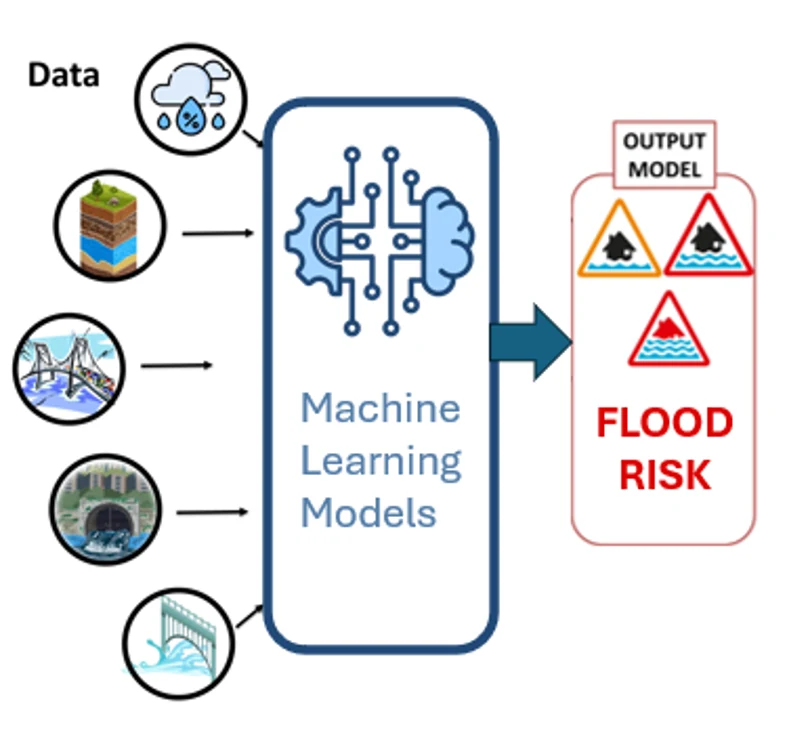
Flood-risk planning is fundamentally a prediction problem under uncertainty. This study evaluates three machine-learning approaches—Random Forest, LSTM and SVM—for estimating infrastructure-related flood risk.
Modeling risk
The analysis uses 2,634 bridge records. Risk is decomposed into two components:
- Exposure, capturing environmental and hazard-related variables
- Criticality, representing the importance and vulnerability of infrastructure
These components are then combined into an overall risk score.
Model comparison
For exposure prediction, Random Forest achieved the lowest error (MAE 0.41, MSE 0.25). It was also strongest for criticality (MAE 0.38, MSE 0.11). For final risk-score prediction, LSTM achieved the best result (MAE 0.31, MSE 0.11).
| Target | Best model | MAE | MSE |
|---|---|---|---|
| Exposure | Random Forest | 0.41 | 0.25 |
| Criticality | Random Forest | 0.38 | 0.11 |
| Risk | LSTM | 0.31 | 0.11 |
Why different models win
Random Forest is powerful for nonlinear relationships in tabular features and is often robust without heavy preprocessing. LSTM, meanwhile, can represent structured dependencies when data have an ordered or sequential character.
The broader engineering point is that there is rarely a universal “best model.” Model selection should follow the structure of the target problem and the error that matters operationally.
Application
More reliable flood-risk estimates can support infrastructure planning, prioritization of mitigation measures and disaster-preparedness decisions.